


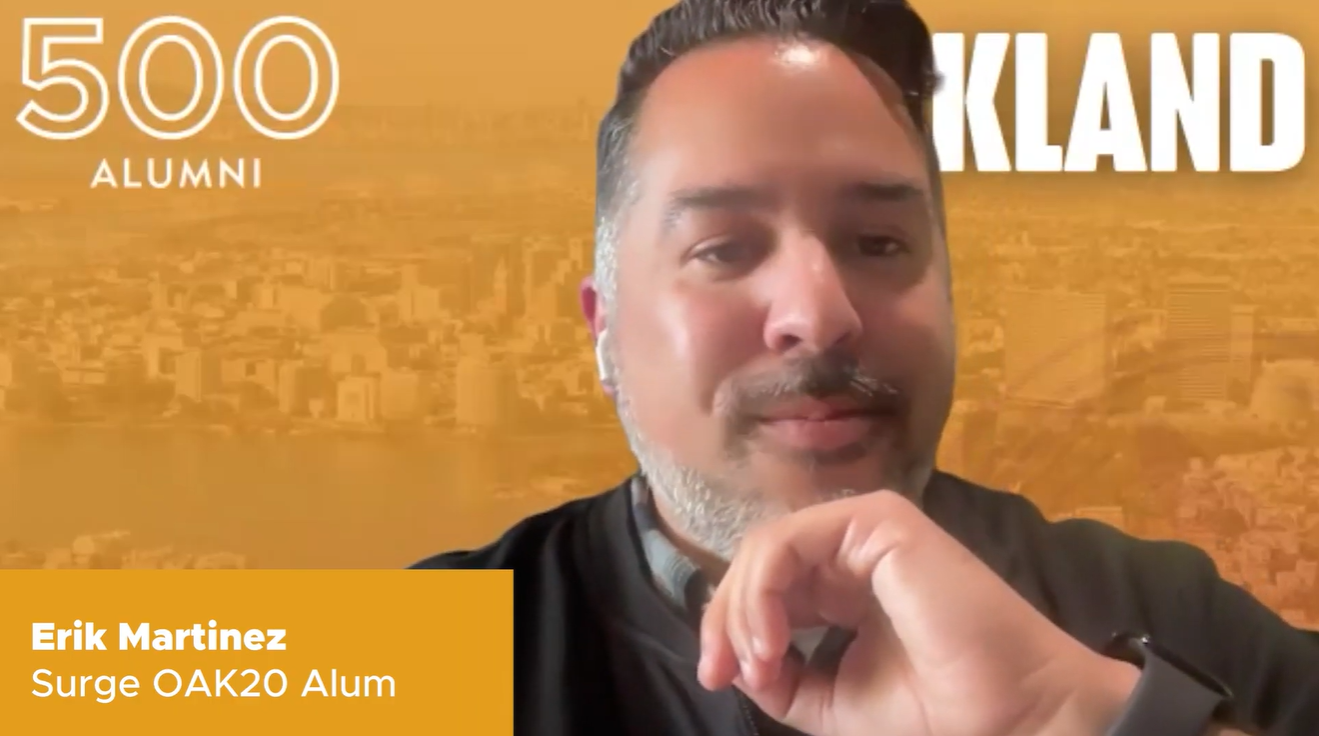


Throughout June, Surge will be joining communities across the country in celebrating Pride Month and uplifting the leadership, experiences, and impact of LGBTQIA+ individuals. Today, we spotlight Surge Alumni Erik Martinez (OAK20), who is making a meaningful impact by creating more affirming, inclusive, and empowering spaces for others.
Erik currently serves as the Director of Behavioral & Mental Health Pathways for the Alameda County Office of Education.
What does Pride Month mean for you?
What we sometimes understand, and experience, is a Pride parade, right? The sponsors, the logos, and the big celebration can obscure the real purpose of it all. The purpose is ongoing visibility, ongoing reminders to share our struggles in remembrance of those who've lived and died for our rights, or access to representation, or access to all the things that are required for us to live happy, healthy lives and to thrive as out queer people. And I think, importantly, parades are a reminder around resistance, remembering that the fight continues. Equal rights have not been achieved. We're really fortunate in the state of California to have a certain number of protections, but that's not shared across all states.
Pride Month is an opportunity to remind ourselves to engage in mutual care, to be a community that's constantly looking out for each other, not just our friends and chosen family, but the other letters of Alphabet soup who are part of the LGBT community. We are looking out for our queer women, for non-binary folks. We are refusing to disappear. Because even in these moments of huge regression, where rights are taken away, the fight will continue. We will not go into silence. Because we understand that silence equals death, and that’s not going to happen.
Why is it important to both acknowledge and affirm our communities and make space for LGBT people?
For me, it boils down to this: Accepting my queerness and being rooted in my queerness is like its own special power. It's one thing as a Latino to be born in the community that I am in, and to accept and receive those gifts from my family and my community through language, through custom, through culture, through storytelling. That is all well and beautiful.
Queerness, for me, reveals an additional layered history. It’s one that I inherit, because those who pave the way, who create the culture, who create the knowledge, who are the holders of wisdom aren't necessarily biologically related to me, or as accessible to me in my community, because it's such a vast range of people. Queerness offers a special perspective and knowledge.
When I look at larger systems, queerness helps me look at what continues to be marginalized. It helps me look at what stories continue to be untold, and the ways in which gender, relationships, love, and mutual care are not always examined critically in education. This can give way to particular hegemonic thinking around what you should look like, the types of relationships you should be in, and how you should perform your gender. Queerness helps me interrogate that, and then look within our systems. How are we replicating hegemonic thinking around gender, around relationships, around kinship, around intimacy? And then, where are there opportunities that are age- appropriate through K-12 to help young people really reflect on their own sense of self?
When we make space and affirm LGBT students, we are affirming and dignifying the full range of expression, the full range of humanity, and seeing and uncovering what's possible for all of us.
What historical figures within the LGBTQIA+ movement inspire you?
I am constantly drawing inspiration from historical figures like Sylvia Rivera, Marcia P. Johnson, Audrey Lorde, and Bayard Rustin, all of whom are so key and foundational in modern queer rights. Also, local figures like José Sarria, who was the first queer, Latino, or Latina person to run for public office. They didn't succeed, but helped to inspire those who were seeking public office to understand that we can bring our identities, our full selves, to serve not just our community, but a whole municipality, a whole group of people. These are the people who are so important to the rights that I currently enjoy as a queer Latine person. They illustrate what it means to survive and to navigate times when there's less affirmation, less visibility, and less celebration for our identities. They represented Pride when it wasn't necessarily a parade or a celebration; it was an act of resistance. That’s something that I continue to draw from as well.
Would you talk about the joy you experience in your relationship with your partner?
I'm really, really blessed to be in a relationship and partnership with somebody with whom I share a lot of common experiences and identities. We are both from the Central Valley of California, which, outside of the Bay Area, can feel like a different part of the country. Both of us grew up in small towns as young queer boys, queer Latino boys, and being super nerdy, there is a lot that we can relate to each other.
So much feels seamless in our relationship because there's just shared and mutual understanding. We’re both really fortunate, that given our circumstances, we both come from families that are openly loving and accepting of who we are, that have both actively participated in the celebration of our relationship, and have been involved in our marriage.
This has given me the power and strength to do what I do. I'm really grateful and privileged to have that experience and have that support at home. But it's something that I want for all of us. If our queer futures are going to be rooted in love, belonging, and mutual care…If that is something I get to experience in abundance, I want to make sure that's something that others have in abundance also.
What has the Surge experience meant for you?
I joined the Oakland cohort in 2020. For me, Surge fulfilled what I had hoped it would do: not only did the experience ground me in technical skills around leadership, but it also helped me understand my ability to use the various parts of my identity - my values, the wisdom and knowledge of the communities which I serve and come from - with a kind of institutional responsibility. How do we shift a system that has not historically been built for us to better serve us?
I had an amazing experience. I definitely walked out of Surge feeling more confident, not just in terms of my skills as a leader, but as a more well-rounded leader, more deeply rooted in my community. Before Surge, I had friends and colleagues in my school district. But after Surge, I felt like I had the cohort behind me.
Surge was such a transformative experience. And I believe the experience helped me feel more confident pursuing other leadership roles, both in my previous district (San Francisco) and now in Alameda County.
.png)