


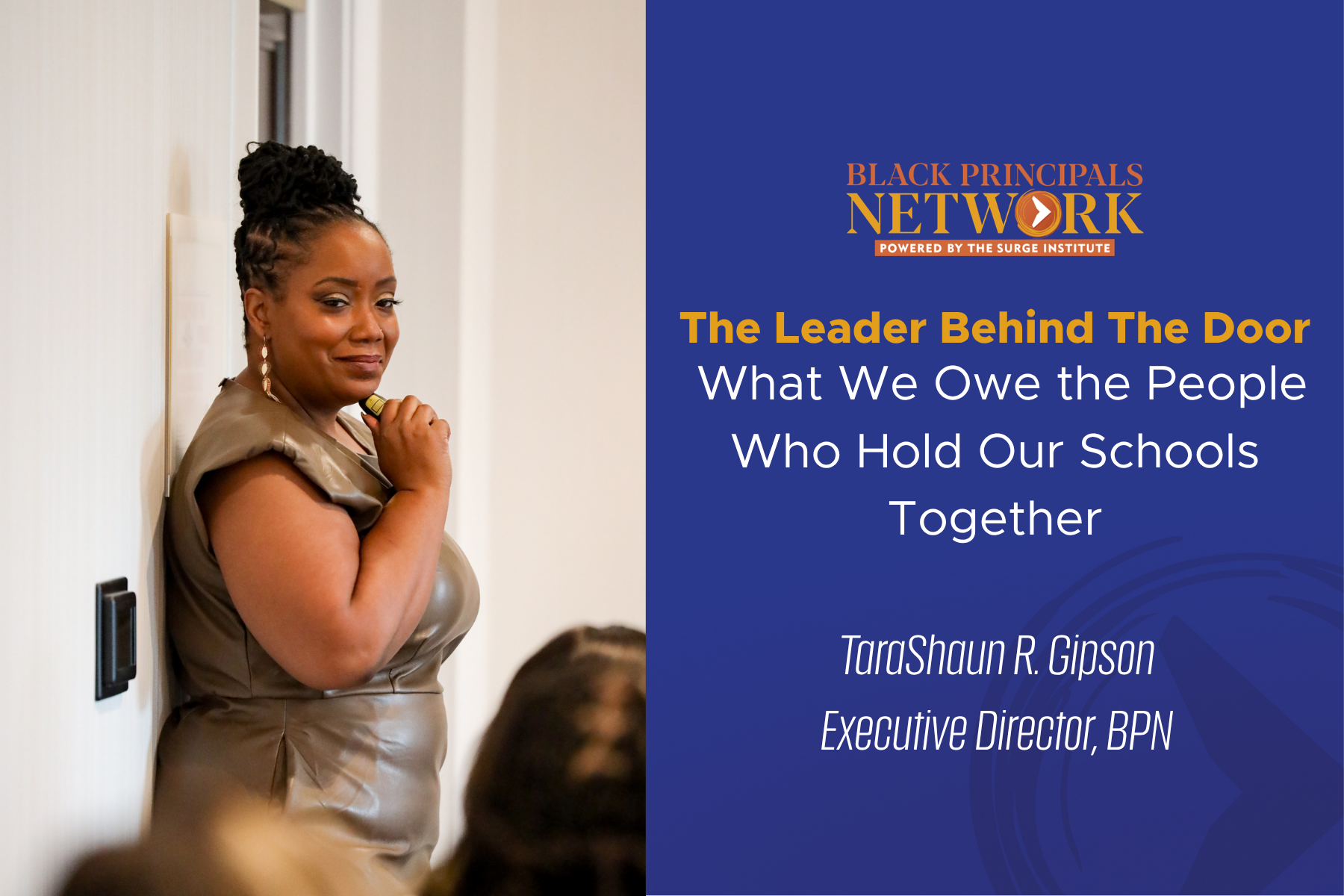


TaraShaun R. Gipson, executive director of the Black Principals Network, shares her perspectives on the hidden cost of leading a school, the history behind the weight Black principals carry, and why the path to student outcomes runs directly through leader health.
Every year on School Principals’ Day, we celebrate leadership.
We post gratitude. We name impact. We lift up the role.
Someone posts a graphic. Colleagues tag their principal. A few heart emojis. A "they work so hard" in the comments.
And by Monday, the weight is right back where it was.
I want to do something different this year. I want to actually talk about what it costs to be a principal. And what it costs our students when we don't.
Because behind every thriving school is a human being carrying far more than what is written in any job description. I have lived inside that reality. And through my work with the Black Principals Network, powered by Surge Institute, I have walked alongside hundreds of school leaders who are living it right now. What I’ve noticed is the weight of this role is rarely visible to the people who benefit most from it.
The Weight
What no one sees when the door closes
There is a version of the principalship that people think they understand. The hallway presence, the graduation stage, the morning announcements. But that version only tells a fraction of the story.
What most people never see is the constant emotional calculus happening behind it.
It looks like managing a student crisis, a staff conflict, and a budget deadline in the same afternoon and then being expected to show up to the next meeting fully present. It looks like receiving news of a personal loss and still walking through the door the next morning, because the school cannot wait for grief. It looks like missing family moments, skipping your own medical appointments, and running on a kind of fuel that is not sustainable. Not because we don't know better, but because the role demands it and we love our schools and communities enough to comply.
It looks like slowly losing track of who you are outside of the job, because the job has filled every space that person used to occupy.
This work does not stop at your calendar. It follows you home. It sits in your body. And it asks for more than the job description will ever admit, or most will ever see.
This is not the experience of a struggling leader. This is the experience of a committed one. And it is happening in schools everywhere, largely in silence, because we have built a culture that mistakes endurance for excellence.
The Historical Context
The weight Black school leaders carry has a longer story
For Black school leaders, this experience is layered with something deeper than burnout. It is layered with history.
After Brown v. Board of Education in 1954, an estimated 38,000 Black educators lost their jobs as schools desegregated (Fultz, 2004; Hudson & Holmes, 1994; Tillman, 2004), a figure scholar Leslie T. Fenwick argues is a significant undercount, documenting in Jim Crow’s Pink Slip (Harvard Education Press, 2022) that the true number may be closer to 100,000. Black principals who had led entire communities with distinction were pushed aside, their expertise deemed unnecessary, their schools closed, their leadership erased.
What was lost was not just employment. It was legacy, cultural grounding, and the infrastructure of a community's belief that their children deserved to be led by someone who knew them from the inside out.
Decades later, that history is not behind us. Black principals are still overrepresented in schools with the highest need and the fewest resources. Still navigating systems that were not designed for us, while being expected to transform them, and doing it more often than not without the infrastructure to sustain that work. It is precisely this history that the Black Principals Network was built to address.
The Research
The numbers behind the weight
The Wallace Foundation has established for years that school leadership is second only to classroom instruction in its impact on student outcomes. The RAND Corporation found that nearly half of all principals report frequent job-related stress, higher than almost any other profession in public life. And principals are not just stressed. They are stretched: most work between 60 and 70 hours per week during the school year.
~50%
of principals report frequent job-related stress, higher than most other professions (RAND, 2022)
60–70 hours
on average, principals work per week during the school year
The Learning Policy Institute has found that when principals leave, the consequences move downstream fast. Teacher retention weakens. Student achievement follows. The schools that lose leaders most often are the ones that can least afford the disruption.
We know principals matter. What we have refused to reckon with is what we are asking them to sacrifice in order to matter.
The Myths
The assumptions doing the most damage
Myth 1: The best leaders don’t need support. They figure it out.
Sustainable leadership requires replenishment. What the research actually tells us is that principals who have access to professional networks, peer coaching, and dedicated learning communities are more effective — and stay longer. Sustainability is not a personality trait. It is a condition. Either the environment creates it, or it doesn't.
Myth 2: The principal's emotional state is a personal matter, not a school one.
Principals set the emotional tone of their buildings. A leader's stress response and capacity for empathy directly shape teacher morale, staff retention, and the psychological safety students experience every day. Emotions are not contained. They are transmitted.
Myth 3: If a principal is struggling, it’s a performance issue.
Burnout is not a sign of poor leadership or personal weakness. Research from RAND and the Learning Policy Institute points to structural isolation as a key driver. Principals are often the only person in their building at their level, with no colleague to debrief with and no peer to call when the day unravels. That is not weakness. That is the architecture of the role.
Myth 4: Wellness programs are the answer.
Wellness programming does not address a 68-person evaluation caseload. Offering leaders a tool for personal resilience while leaving the structural conditions unchanged is not support. It is the appearance of support. What leaders actually need is community. What they need is infrastructure.
Myth 5: Student achievement is about instruction alone.
The health of the leader and the achievement of the child are not separate equations. They never were. Survival cannot be the standard for leadership. And yet, for far too many principals, it is exactly what the conditions require.
The Student Achievement Equation
The variable no one is writing about
We write constantly about the factors that drive student achievement: curriculum quality, instructional rigor, family engagement, early literacy, social-emotional learning. These are all real and vital.
But there is a variable sitting at the top of all of them that receives almost no attention: the health of the person leading the school. The numbers bear this out. Research from How Principals Affect Students and Schools (Grissom, Egalité & Lindsay, 2021) found that having an effective principal translates to the equivalent of 2.9 months of additional math instruction and 2.7 months of English instruction for students. That is not an abstraction. That is a third grader who never gets those months back.
Think about what that means concretely. A third grader who has had the same principal for four years has experienced continuity of vision, consistent relational culture, and stable leadership through every hard moment the school has faced. A third grader whose school has cycled through three principals in four years has experienced disruption of trust, shifting priorities, and the quiet message that the adults in charge do not stay.
Children absorb that. It shapes how safe they feel. How much they risk. How willing they are to try.
When a principal is depleted, isolated, unsupported, surviving rather than leading, that cascade works in reverse. Decision-making becomes reactive instead of visionary. Staff morale erodes. Good teachers leave. The climate shifts in ways students feel before any adult names it.
Investing in the social and emotional health of a principal is not a distraction from student outcomes. It is the most direct investment in student outcomes available to us. And we have been leaving it on the table.
The Turning Point
A moment that stopped a room
At our Southern Regional Leadership Summit in Atlanta, TLC23 alum JuDonne Dawson said something that landed like a truth people had been waiting years to hear out loud.
“Martyrdom is not a character flaw. It is an adaptation to a system that requires it.”
—JuDonne Dawson, TLC23 Alum, Black Principals Network's Southern Regional Leadership Summit
Sit with that.
So many school leaders, especially Black school leaders, have not been overextending because of poor boundaries or a lack of self-awareness. They have been overextending because the systems around them required it, rewarded it, and offered nothing else in return.
Naming that is not an excuse. It is a diagnosis. And you cannot treat what you refuse to name.
Sustainability is not a personality trait. It is a condition. Either the environment creates it, or it doesn't.
What Works
What happens when the conditions actually change
That moment at the Southern Regional Leadership Summit was not an accident. It is what happens when leaders are given the conditions to speak honestly, to be restored, and to be in community with people who understand the specific texture of what they carry.
The Black Principals Network exists at a simple but radical intersection: professional excellence and human wholeness. The belief, held as a founding principle and not an afterthought, is that you cannot sustainably have one without the other.
Through Regional Leadership Summits, The Leadership Collaborative, and monthly programming, BPN builds the structures the broader education system has rarely prioritized. Every touchpoint is designed to examine the full scope of leadership: the hard skills and the soft skills, the visible work and the invisible weight.
Community
Who holds you?
Professional Growth
What are you building?
Restoration
What are you releasing?
Liberation
Who are you becoming?
When leaders step into those spaces, something measurable shifts.
95%
felt genuinely affirmed and supported as leaders
92%
feel more equipped to lead sustainably
92%
said the experience delivered on its purpose
92%
rated the overall experience as excellent
These are not satisfaction scores. They are evidence of what becomes possible when a leader is seen, restored, and in community with people who understand what they carry.
Refueled leaders lead differently. They stay longer. They build with more steadiness. Their teachers feel it. Their students feel it. The data follows.
Spaces like the Black Principals Network are not an add-on. They are infrastructure. They are part of how we stabilize leadership, strengthen schools, and protect the conditions every student needs to learn and grow.
We cannot celebrate leadership without investing in it.
The Call
This is everyone's responsibility
The conditions that sustain or exhaust a school leader are not shaped by the leader alone. They are shaped by the decisions of the people and institutions surrounding them.
For Funders
Invest in the leader, not just the school.
Fund the infrastructure that holds leaders: peer networks, leadership cohorts, professional community, and the time and space to be restored. Sustainability is not a program add-on. It is a precondition for every outcome you care about. When you fund a school, you are funding a leader. Fund them accordingly.
For District Leaders
Design conditions, not just expectations.
Examine honestly what you are requiring of principals versus what you are providing. Reduce structural isolation. Protect time for professional community. Measure leader well-being with the same urgency you apply to student outcomes.
For Communities and Families
See the whole person leading your school.
Your principal shows up for your child every single day. Advocate alongside them. Push for systems that support them, because a sustained, healthy, present leader is one of the greatest gifts a school community can give its children.
For Principals
Asking for support is not a departure from excellence.
It is a prerequisite for it. Sustainable leadership is not solo leadership. When the work lives in one person, it is always one breaking point away from collapse. Distributed leadership is not abdication. It is architecture. You are no longer the ceiling when you become the conditions.
To every principal reading this
What you have been carrying is real. The grief processed in the margins of a meeting, the health set aside, the family moments missed, the version of yourself quietly left behind. None of that was weakness. It was what the conditions required. You deserved better conditions. And we are building them.
We see the 6 a.m. arrival and the 7 p.m. departure. The parents' email answered on Sunday night. The student you stayed for when your own family was waiting. The staff member you poured into when your own cup was running low. The decision made alone at midnight that no one will ever know about.
You are the work. And you are worth fighting for.
We will never secure the futures of our children by burning through the people dedicated to building them.
Happy National School Principals’ Day — not just for what you do, but for who you are while you do it.
Follow the Black Principals Network on LinkedIn and Facebook.
.png)