


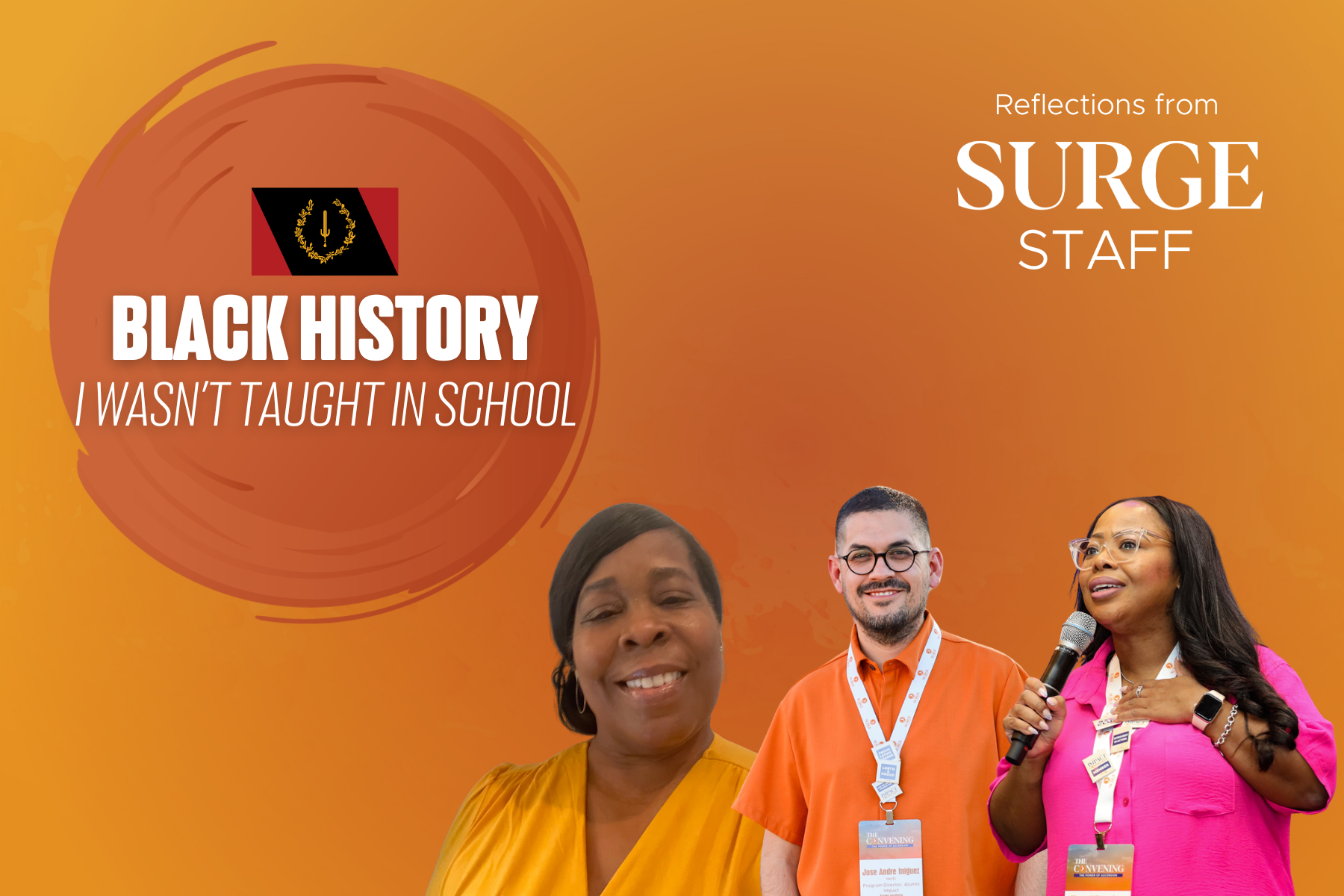


In part one of this two-part series, we asked members of the Surge staff to reflect on a powerful piece of Black history they learned as adults.
Black history is U.S. history. And world history.
This year marks 50 years since Black History Month was first officially recognized in the month of February, after President Gerald Ford signed a federal proclamation in 1976. Culturally, however, the origins are traced back to Carter G. Woodson’s founding of Negro History Week in February 1926. Happy centennial!
As important as teaching history is to educating youth, what you may have learned of Black history can vary greatly depending on when and where you were educated. But a consistent takeaway is that there is a lot about our history we weren’t taught.
Here are a few of our stories, as shared by Surge staff.
Experiencing the Real Africa
By Tiara Wheatley, Chief of Staff
In February of 2025, I traveled to several countries in East Africa, and that experience fundamentally reshaped my understanding of Black history in a way school never offered me. Standing on the continent where humanity began, made it impossible to ignore how much of Black history has been minimized, fragmented, or erased in formal education. Growing up, Africa was often taught as a place of lack or loss, rather than as a rich, complex source of culture, innovation, spirituality, and global influence. Being there—experiencing the land, the people, and the living continuity of history—replaced distance with connection and abstraction with truth. It reminded me that Black history does not begin with enslavement, but with origin, genius, and resilience. That realization deepened my sense of pride and belonging and helped me see my own story as part of something far older and far greater. Our youth deserve this knowledge early, because when young people understand where they come from, they carry themselves differently. Teaching this history is essential not just for awareness, but for identity, confidence, and liberation.
The Hunger for Knowledge
By José M. Andre Iniguez, Vice President, Alumni Impact
Growing up, I was never taught about the Black Panther Party’s community programs, such as their Free Breakfast for Children Program. When I was “taught” about the Party, the dominant narrative framed them as dangerous or extreme. Throughout my K-12 education, my family qualified for free and reduced lunch, and those meals mattered more than I could articulate at the time. Even when things were hard at home, being fed at school meant I could show up focused, present, and ready to learn. During the summers, my siblings and I would walk a few blocks to our neighborhood elementary school to make sure we still had access to meals, a reminder that food security was never guaranteed. It wasn’t until early adulthood that I learned the Black Panther Party had been trailblazing this work decades earlier by feeding children, meeting basic needs, and building systems of care when the government would not. Learning this reframed the Panthers for me as visionaries who understood that education, dignity, and liberation begin with nourishment. This is a piece of Black history our youth deserve to know (and to know fully and accurately) because it teaches that community care is a powerful form of resistance and that meeting people’s basic needs is an act of love and leadership.
The Revelation of Our Origin Story
By Sonja Brown, Marketing Program Manager
There’s a remarkable Trans-Atlantic Slave Trade Database that compiles information on more than 36,000 voyages that transported enslaved Africans across the Atlantic Ocean between 1514 and 1866. I searched the voyage records of “Whydah, Ouidah,” highlighted as a principal port of purchase for my ancestors as captives. The connection I'm drawing between “Whydah” and the “Kingdom of Judah” represents my deeply personal spiritual interpretation. One that resonates with Hebrew Israelite theology: The belief that I, as a descendant of enslaved Africans, am part of the true biblical Israelites scattered during prophesied captivity. For my spiritual journey, recognizing these voyage records as documentation of Deuteronomy 28’s curses, my ancestors being transported to lands in ships to serve oppressors, creates an unshakable foundation where my history and scripture converge with devastating clarity. The emotional and psychological impact of understanding my lineage as the chosen people, rather than a race defined by enslavement, fundamentally restructures my identity from victimhood to divine inheritance and purpose. For young Black people today, this truth could provide us with unbreakable spiritual armor: A sense of belonging to an ancient, resilient, divinely appointed people whose story didn't begin in chains but in covenant.
.png)